
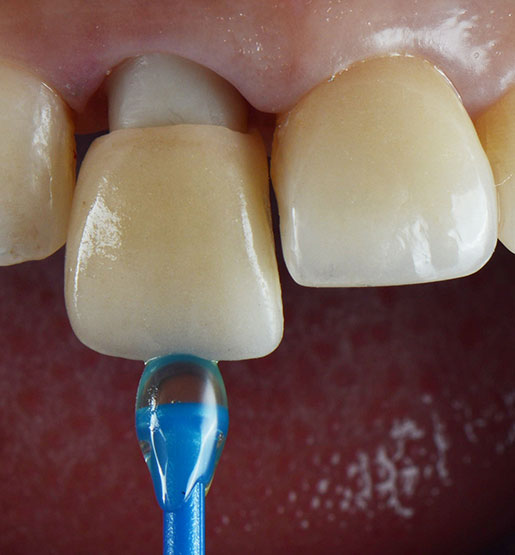
Dental implant rehabilitation in Monterrey
Dental implant rehabilitation is the final phase of treatment. It involves designing and placing the definitive crown, bridge, or denture on implants that have already integrated, to restore the function and esthetics of your smile.
Contact us to schedule an evaluation.
Phases of Dental-Implant Treatment
Dental implants replace tooth roots and act as anchors. They are surgically placed in the bone and take 3 to 4 months to osseointegrate, which allows them to bear mechanical loads without dislodging. This stage of treatment is known as the surgical phase.
The prosthesis is fabricated once implant osseointegration is complete—although the type of prosthesis to be placed on the implant is determined from the very start of planning.
The prosthesis is attached to a prosthetic abutment (a post screwed onto the implant). The type of prosthesis determines the abutment type, shape, and material.
There are several types of implant rehabilitation:
- Single crown: when only one tooth is missing.
- Cantilever crown: when two adjacent front teeth are missing.
- Fixed bridge: when three or more consecutive teeth are missing.
- Removable partial denture: when multiple teeth are missing in one arch and a fixed solution is not desired.
- Fixed full-arch prosthesis without palate or posterior extension: when all teeth are missing in one arch and a completely fixed option is desired.
What are the steps to rehabilitate an implant?
1. Implant exposure
After the implant has fully healed, the gum covering the access to the implant screw is removed and an abutment is placed that emerges through the gum.
2. Impression taking
An impression post is placed in the patient’s mouth to transfer the shape of the gum, the teeth, and the exact position of the implant. The impression is sent to the lab to begin fabrication of the prosthesis.
3. Prosthesis try-in
Once the prosthesis is finished, it is tried in the patient to make any necessary adjustments in shade, shape, and bite.
4. Final placement
The definitive prosthesis is delivered. The patient should be able to eat normally and feel no discomfort. The active rehabilitation phase concludes here.
5. Maintenance
The prosthesis and implant should be checked every 4 months during the first year; after that, once a year is sufficient. This step is essential to ensure healthy tissues around the implant, proper prosthesis function, and to prevent peri-implant diseases.
Frequently questions about dental-implant rehabilitation
A restored implant consists of the implant (screw), a prosthetic abutment, and a crown. The implant functions like a tooth root and anchors the prosthesis. The abutment connects the implant to the crown, which is the visible part that imitates a natural tooth.
Diagnosis, radiologic evaluation, treatment planning, laboratory fees, the materials required depending on the case (titanium implant, membranes, bone, etc.), the specialist’s fees and follow-up, and the cost of prosthetic components and the crown are among the most important factors that determine the final price of a restored implant.
Like natural teeth, implants accumulate food debris that promotes bacterial growth. It’s important to maintain good oral hygiene with toothbrushing at least twice a day and daily flossing.
Crowns do not change color like natural teeth. Whether porcelain or zirconia, they retain the shade with which they were made. If, for esthetic reasons, you decide to whiten your natural teeth, a new crown must be fabricated to match the new tooth shade.
If you’re looking for a definitive solution to tooth loss, we invite you to contact us.
Schedule an evaluation to receive a precise diagnosis and a detailed treatment plan.