
Dental Veneers in Monterrey
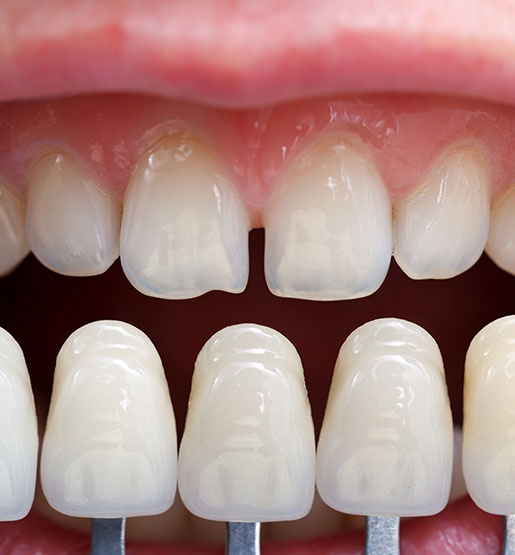
Dental veneers are thin shells placed on the front surface of teeth to correct defects in size, shape, color, wear, and enamel deformities.
Don’t wait any longer! Contact us now to book your appointment.
Materials, Longevity and Procedure for Dental Veneers
Veneers are generally made of porcelain, although depending on each case they can also be made of resin/composite or lithium disilicate.
Veneers are fabricated in a dental laboratory after the dentist takes an impression of the teeth. They typically range in thickness from 0.3 mm to 1 mm. When made of porcelain, they last 15–20 years, while resin/composite veneers last 5–10 years.
Porcelain has ideal properties as a restorative material. Different shades are combined artistically and by hand by the lab technician to achieve the appearance, texture, and translucency of natural teeth. Dental porcelain is highly resistant to external agents, so veneer color remains stable over the years.
To place veneers, the dentist must gently trim the enamel and slightly reduce tooth size to compensate for veneer thickness. After this step, the veneer is bonded firmly with a special resin.
Regardless of veneer type, care is the same as for natural teeth. Patients should follow proper oral hygiene to keep them healthy. Dentists recommend brushing three times a day with meals and using dental floss to ensure thorough cleaning of all surfaces.






Request an appointment for an evaluation.
Frequently asked questions about dental veneers
Most people can get veneers. They are usually recommended to treat:
- Discolored and/or worn teeth.
- Irregular teeth or gaps.
- Chipped teeth.
No. There are three main reasons veneers aren’t recommended:
Severe tooth crowding: when teeth are very misaligned, orthodontic treatment is advisable to achieve optimal results without excessive tooth reduction.
Malocclusion problems: when the patient does not have a good bite, veneers are contraindicated due to fracture risk. As above, the advisable route is to begin orthodontic treatment.
No. The procedure is not invasive or painful because it is performed under local anesthesia to minimize any discomfort.
No. Fortunately, technological advances allow minimal changes to the tooth surface. This depends on four factors:
- Tooth color.
- Position: whether the tooth is out of alignment.
- Anatomy: whether they are canines, premolars, incisors, or molars.
- Existing restorations.
No. Veneers cannot be whitened. That’s why it’s necessary to confirm the correct shade beforehand.
This is achieved through try-ins the dentist performs with the patient to determine the most appropriate color, shape, size and position.
No. Veneers do not stain, but natural teeth do. To avoid a mismatch between veneer color and tooth color, it’s essential to maintain good oral hygiene.
Veneer treatment typically takes four appointments: exam and impressions, tooth preparation, try-in, and final placement.
Book an evaluation
Dental veneers are an effective solution to correct imperfections in your teeth’s shape, size, or color.