
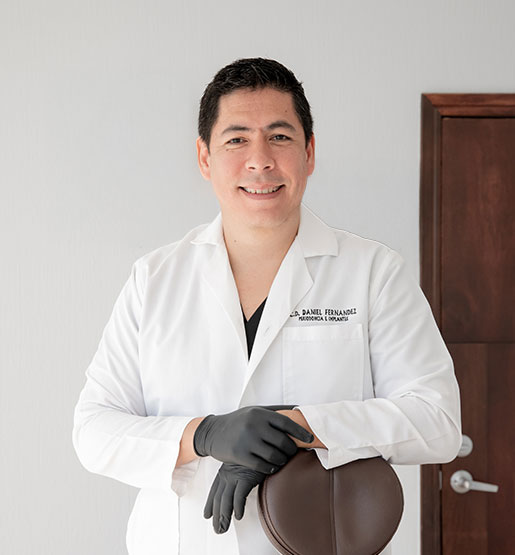
High-quality dental implants in Monterrey
Dental implant specialist in Monterrey
If you’re seeking a safe, long-lasting solution to replace missing teeth, our team of specialists focuses on implant placement to restore function and your confidence when you smile.
Periodoncista en Monterrey
What are dental implants?
There are several types of dental prostheses to replace a missing tooth, but dental implants are by far the most comfortable, effective, and durable solution. In fact, the development and use of implants is one of the greatest advances in dentistry over the past 40 years.
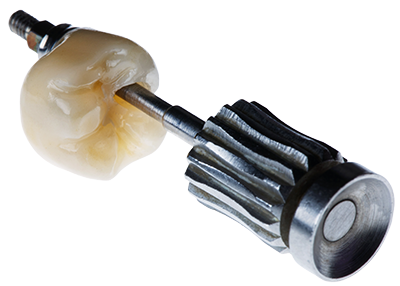
A dental implant is a metal component surgically placed in the jawbone beneath the gum. It’s designed to replace the missing root and hold the artificial tooth in place.
Most implants are screw-shaped and made from biocompatible materials that do not trigger rejection and allow bonding to bone through osseointegration, a process in which bone cells adhere to a metallic Surface usually titanium.
What are the advantages of dental implants?
An implant treatment offers benefits that go far beyond esthetics, significantly improving health and quality of life. Here are the key advantages you’ll gain with implant surgery at our clinic in Monterrey:
They prevent deterioration of your remaining teeth
The empty space left after losing one or more teeth can cause your bite to shift to compensate, making healthy teeth gradually lose support, move, and even be lost. As tooth positions change, contacts become imbalanced, leading to overload, pain, and wear. In addition, removable dentures can severely wear down the teeth that support them and may even lead to their loss.
Superior support and stability when chewing
The main advantage of dental implants in Monterrey over removable dentures is that they provide excellent support and stability while chewing. Since dentures are not fixed in place, they can move when trying to eat solid foods, causing discomfort. Dental implants help you chew a wide variety of solid foods that would be impossible to eat with other dental replacement systems, such as certain meats or fruits.
Improve self-esteem
Missing teeth can undermine self-confidence. Beyond the obvious esthetics, speech and phonation are also affected. Because implants look and feel like natural teeth, they help you recover confidence when smiling, speaking, and eating.
By replacing the roots of the teeth, the bone is better preserved
By replacing tooth roots, implants help maintain bone volume. With conventional dentures, by contrast, the bone that once housed natural roots often resorbs over time.
They do not harm neighboring natural teeth.
Fixed bridges and removable partials rely on neighboring teeth for support, wearing them down. Implants are anchored in the missing tooth’s bone, so they don’t compromise adjacent teeth.
Long-lasting solution
Success rates are very high over 90%. With proper care, implants can last many years, making them an excellent long-term investment for those missing one or more teeth.
Schedule a consultation to begin your treatment.
How does the implant process work?
In general, implant treatment involves four phases:
- Diagnosis & planning
- Surgery
- Prosthetic restoration
- Maintenance
Implant surgery is a very safe and effective treatment. If you’d like to know more about our protocol, our team can explain each step in detail during your evaluation.
How much do dental implants cost in Monterrey?
The cost varies according to each patient’s condition, the complexity of the procedure, and the number of teeth to be replaced.
While implants may seem expensive initially, remember that with optimal care, they can last a lifetime. Their functionality, esthetics, and comfort aren’t matched by other replacement options.
For this reason, the best first step is to come in for an evaluation to receive a personalized estimate.
To get an accurate quote, please book an evaluation appointment.
Frequently questions about dental implants in Monterrey
Not all implants are the same; they vary depending on their design or shape, material, and quality. Consequently, prices also vary. At our clinic, we work exclusively with brands that manufacture dental implants of proven quality, aiming to offer the best possible long-term results.
The vast majority of high-quality dental implants are made of titanium, which has the property of osseointegration, meaning it fuses with the bone. Furthermore, titanium and its alloys are the most commonly used materials for manufacturing prostheses that come into contact with bone.
According to scientific studies, dental implants can last approximately 30 years. However, their lifespan depends on good oral hygiene and regular checkups performed by a periodontist.
Most people can get dental implants without problems. As a general rule, the patient must be over 21 years old if male and 18 if female, when bone growth has finished. However, there is no upper age limit. In fact, one of the great advantages of implants is that they improve the quality of life for older patients.
The dentist who places dental implants must be highly trained in oral surgery and the management of both soft and hard tissues, as well as have a solid foundation in implant rehabilitation. They also need to be able to evaluate radiographic studies of the implant site and develop an appropriate treatment plan. Periodontists are trained in all these areas and are therefore the most qualified to place dental implants.
There is a belief that dental implants feel like a foreign object and do not have the same functionality or aesthetics as natural teeth; however, many people claim to feel a greater sense of naturalness, security, and firmness compared to their natural teeth.
It’s common for many dental clinics to offer very low-cost dental implant quotes; however, these attractive prices often include additional costs such as abutments, prosthetic accessories, and suture removal. What initially seemed like a very affordable price ends up costing the same or even more than at more reputable clinics.
It’s recommended that anyone interested in getting dental implants always request a final quote. A “bait” price attracts many patients, but it’s misleading and unfair.
If the person did not have bad breath before the procedure and maintains good oral hygiene habits, it is unlikely that the dental implants themselves will cause it afterward. Furthermore, oral factors are not the only cause of bad breath; other causes include stomach problems and respiratory infections.
People with diabetes can have dental implants placed as long as their condition is well controlled. Patients with high blood sugar levels are more prone to infections and slower tissue healing, which can lead to treatment failure.
Dental implants are not recommended during pregnancy. During gestation, women experience significant hormonal changes that can cause gum sensitivity and hinder healing. Furthermore, X-rays are required to monitor the implants’ progress, and these can affect the fetus.
This is one of the most frequent questions patients ask when they are interested in getting dental implants. Because titanium has excellent biocompatibility with body tissues, dental implants do not cause allergies or rejection.
Dental implant placement is not contraindicated in people with osteoporosis. Previously, it was thought that a patient with low bone density could affect the osseointegration of the implant to the bone. However, new techniques have been developed to promote new bone formation, making implant placement possible.
Dental implants are contraindicated in people who suffer from serious heart disease or who have recently suffered a heart attack, who are undergoing cancer treatment (chemotherapy), or who are receiving immunosuppressant therapy. In these cases, the treatment can be performed at a later date. There are also other factors that must be addressed before implant placement, such as periodontal disease.
Since dental implants are made of titanium, there is a possibility that a metal detector could set off a metal detector. However, this possibility is remote, as it depends on several factors, such as the size and amount of metal in the implants, as well as the sensitivity of the metal detector. The metal content of a dental implant is very small; even if you had a full mouth of implants, it is highly unlikely that the metal detector would sound.
Dental implants are not contraindicated for orthodontic treatment. Although implants don’t move, they can be very useful as anchor points for moving the remaining teeth. Therefore, the orthodontist and periodontist should work together to develop the most appropriate treatment plan to ensure the success of both procedures.
The test requested for all patients requiring dental implants is a Cone Beam CT scan. This is a special type of X-ray that, in a single scan, produces 3D images of the teeth, soft tissues, bones, and nerves.
This test helps the periodontist determine the feasibility of the procedure and establish the treatment plan.
The decision to get a dental implant is important.
Take the first step by scheduling a consultation. Contact us now.