
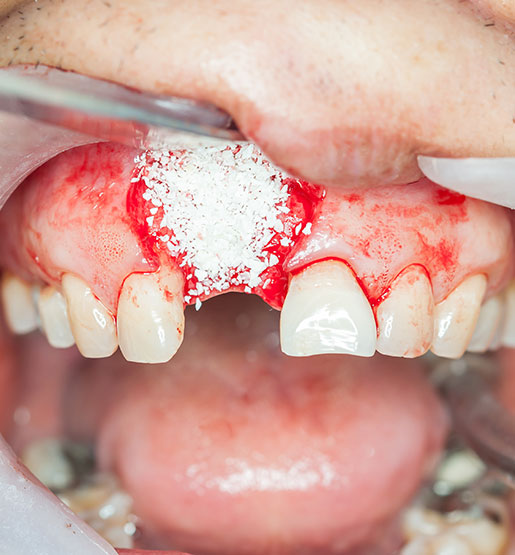
Dental bone graft in Monterrey
A dental bone graft is performed when there isn’t enough bone volume to support an implant. The need for and timing of the graft are determined after a detailed radiographic evaluation of each case.
Contact us to schedule an evaluation appointment.
When is a dental bone graft necessary?
A bone graft is a preparatory procedure in oral implantology. It ensures the dental implant has a solid, sufficient bony base for proper integration and long-term stability.
The main situations in which a bone graft is indicated:
- To preserve the alveolar ridge dimensions after a tooth extraction.
- To fill existing bony defects in the area where an implant will be placed.
- In sinus-lift techniques to gain vertical bone height in the posterior maxilla.
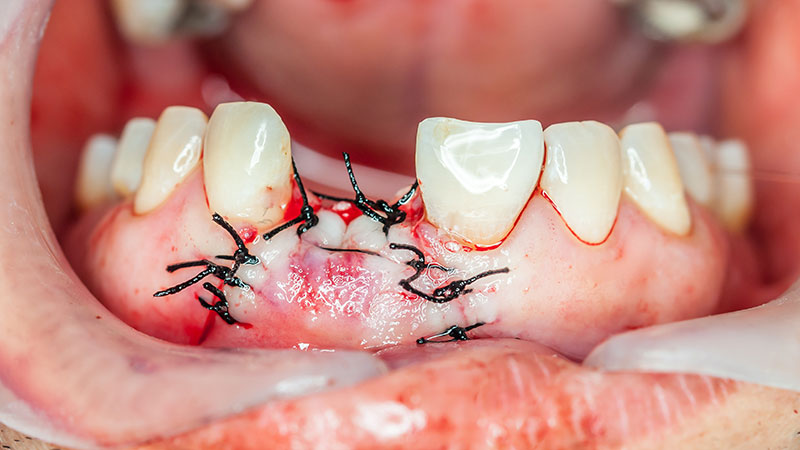
It’s common for some patients to feel anxious or fearful when told they need a bone graft prior to implant placement, assuming it’s a complex and painful procedure.
Thanks to current techniques, bone grafting is performed routinely, and most dentists experienced in implant placement can carry it out without major complications.
In short, a bone graft is simply an aid to achieve implant success and longevity. By grafting, the implant gains a larger, more suitable surface for permanent, secure fixation.
Frequently asked questions about dental bone grafting
The primary role of the alveolar bone is to house and support the teeth within their sockets (alveoli). It supports teeth via periodontal fibers.
Thanks to this bone, teeth remain anchored during chewing, speech, and swallowing, and the bone dissipates the forces generated by these functions. The alveolar bone also protects nerves and blood vessels, as it contains mineral salts such as calcium.
Finally, the marrow within the alveolus participates in hematopoiesis (the formation of blood cells) throughout childhood.
Although the leading cause of jawbone reduction is tooth loss, other factors contribute:
- Advanced periodontal disease: over time, mineralized tartar extends to the root and alveolar bone, causing gradual bone loss.
- Trauma: an impact to the teeth can fracture them and also damage the nerve (leading to calcification) and reduce bone.
- Removable dentures: over the long term, they can accelerate bone resorption.
Bone grafts can be done using different techniques, depending on the patient’s needs:
- Bio-Oss: Indicated for patients receiving a dental implant. It is a compound of hydroxyapatite and calcium, both naturally present in teeth, making it fully biocompatible with the human body.
- Emdogain: Used to regenerate bone around teeth lost to periodontal disease. Emdogain is a protein-based gel that stimulates regeneration of the tooth’s supporting tissues. It can be used as an alternative to or in combination with bone grafting to regenerate tissues around a tooth by activating the patient’s own stem cells to rebuild ligament, cementum, and bone.
- Block bone graft (Splitted Bone Block Technique): A section of the patient’s own bone preferably from the mandible is harvested and fixed to the area where bone regeneration is required.
No. Any bone-grafting technique is performed under local anesthesia, so the procedure itself is not painful. Conscious sedation is also an option for added comfort.
The postoperative course varies according to three main factors: the amount of bone to regenerate, the extent of the surgery, and whether the graft needs to be taken from another area of the mouth, as these will determine the specific care and instructions the patient must follow after surgery.
That said, all techniques share this in common: with appropriate medication and proper after-care, the patient can return to normal daily life with certain limitations.
Depending on the type of bone-regeneration technique and its extent, healing time ranges from 4 to 6 months.
In almost all cases, patients experience rapid recovery. However, the most frequent complication is infection of the grafted material, along with bleeding and swelling in the area; less commonly, there may be injury to a nerve or to the roots of adjacent teeth.
To minimize these risks, the periodontist should clearly explain the after-care instructions, closely monitor recovery, and perform regular in-office checkups.
To prevent gradual, progressive bone loss, removable dentures should be replaced with dental implants.
Another way to limit bone loss when teeth are still present is through periodontal treatment. However, in advanced periodontal disease, teeth with marked mobility should be replaced before additional bone is lost.
It is essential to maintain good oral hygiene and see your dentist regularly.
A bone graft may be the step needed to ensure the success of your dental implants.
Contact us to schedule an evaluation appointment and receive a treatment plan tailored to your case.