
Root Canal: Effective Treatment in Monterrey
A root canal (endodontic treatment) consists of completely removing the tooth’s pulp/nerve. It’s the last resort to preserve teeth whose dental nerve and surrounding tissues are affected.
Call or message us to schedule an appointment!
Symptoms and Causes That Require a endodontic
Deterioration of the dental nerve can present in different ways:
- Discomfort when chewing, either pain or tooth sensitivity.
- Darkening of a specific tooth.
- Bad taste in the mouth due to infection.
- Abscess formation.
Root canals are performed on teeth with deep cavities that cause inflammation or necrosis of the pulp. The dental pulp is the innermost part of the tooth where the nerves and blood vessels are found. Other causes of pulpitis include trauma, erosion, and tooth wear from bruxism (teeth grinding).

Phases of EndodonticTreatment in Monterrey
A root canal in Monterrey is carried out in several phases:
Diagnosis
Your dentist will ask about the type, location, and intensity of the pain. X-rays are taken to check the tooth’s condition and anatomy.
Anesthesia
Local or regional, depending on the case.
Access and isolation of the tooth
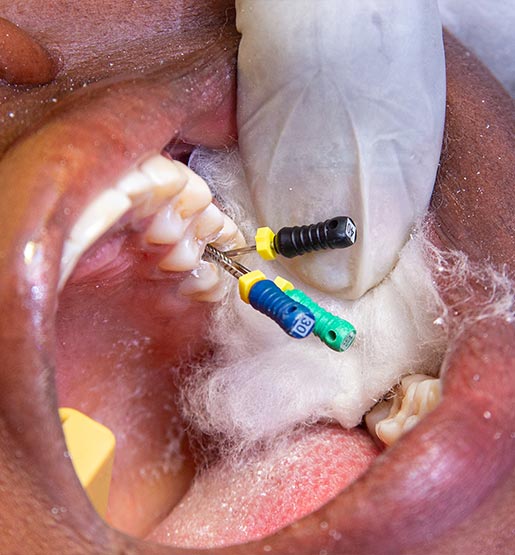
An opening is made in the crown to reach the pulp, and the tooth is isolated from the rest of the mouth.
Instrumentation
The canals are cleaned to leave them free of infected tissue.
Obturation
The canals are sealed, rendering the tooth insensitive.
Control
A post-operative X-ray verifies treatment success. Depending on the case, follow-up is done over weeks or months.
In general, a root canal can be completed in one visit of 1–2 hours. Some cases require 2 or 3 visits, depending on the type of infection.
Request an appointment for an evaluation.
Contraindications to Endodontic Treatment
A root canal isn’t viable in all situations. It’s not recommended when:
- The tooth has a vertical fracture.
- The root is too short to properly support a future Crown.
- There is advanced periodontal disease with significant gum damage.
In such cases, the best option is extraction followed by dental implant placement to replace the tooth.
Benefits of Endodontics vs Tooth Extraction
When treatment is feasible, your specialist will avoid extraction and opt for a root canal because:
- A root canal is less invasive than extraction.
- Even though an implant looks and feels natural, it’s always preferable to preserve your own tooth.
- It prevents problems from not replacing a lost tooth in time, such as occlusion (bite) issues.
A timely root canal can save your tooth.
Book a valuation appointment via WhatsApp, phone call, or through our contact form to receive a precise diagnosis.