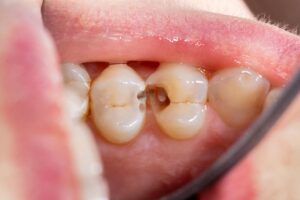
Tooth loss can occur at any stage of life, though it is more common in older adults.
Beyond trauma or accidents, teeth are most often lost due to two main causes:
- Periodontal disease: in its most advanced stage, it destroys the supporting tissues of the teeth, causing them to loosen and eventually fall out.
- Cavities (tooth decay): when damage is so severe that a root canal cannot save the tooth, extraction is necessary to relieve pain and prevent the infection from spreading.
What are the consequences of don’t have teeth?
A person without teeth cannot chew properly and must limit themselves to soft foods, which is uncomfortable.
As chewing function deteriorates, the person is exposed to a range of digestive and nutritional problems. Changes in chewing mechanics can also lead to ear problems, headaches, or neck (cervical) pain.
Today, however, the most significant consequences are psychological. Losing a tooth can cause serious self-esteem issues.
What treatments can replace missing teeth?
When someone loses a tooth and wants to replace it, it’s natural to wonder which treatment option is best.
There are two options to replace one or more teeth: dental implants and dental bridges.
Although both address the same need, each has specific advantages and disadvantages to consider before deciding.
What is a dental bridge?
A bridge is a type of dental prosthesis that rests on the healthy teeth the patient still has. Bridges usually replace adjacent missing teeth, meaning teeth that were next to each other in the mouth.
The bridge is cemented onto the patient’s natural teeth. However, to place it, those teeth must be prepared (shaved down) because the bridge’s crowns fit over them.
In this way, the bridge becomes fixed to the patient’s mouth hence the term fixed dental bridge.
What is a dental implant?
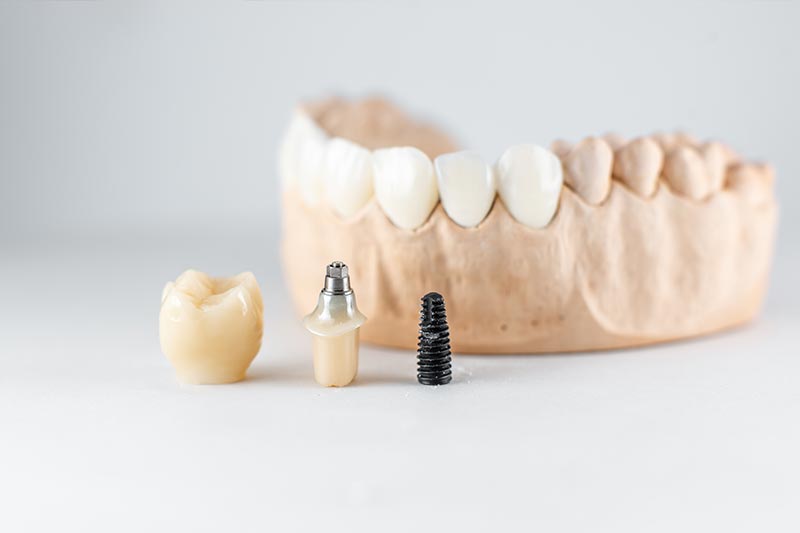
A dental implant is a small titanium screw placed in the jawbone.
The key difference compared with bridges is that implants also replace the tooth root through osseointegration, which helps prevent bone loss.
After the implant integrates with the bone, a dental Crown either zirconia or porcelain-fused-to-metal is placed.
Unlike bridges, when an implant is placed the neighboring teeth are not prepared. Because the implant occupies the empty socket and works independently, it doesn’t need support from other teeth.
What are the advantages and disadvantages of each?
Longevity and strength
Implants are generally the more durable option because they also replace the root and, with proper care, can last 20 years or more.
A bridge’s longevity depends on the health of the supporting teeth. If those teeth develop decay or periodontal disease, the bridge’s survival is compromised.
Esthetics
Both implants and bridges can deliver excellent esthetic results when properly planned and executed.
Dental carving
As noted, placing a bridge requires preparing (shaving) the adjacent healthy teeth.
This carries the risk of damage; if a tooth is reduced substantially, a root canal may be advisable. Moreover, once teeth are prepared, they will always need crowns going forward.
With implants, the other teeth are not affected.
Cost
In practice, implants offer more advantages than fixed bridges. However, implants are typically more expensive than bridges.
If you want to replace missing teeth and are unsure which treatment is best for you, the most advisable step is to book a consultation with a Periodontist. They will examine you, analyze your case, and propose the option that best fits your needs and goals.
This article outlines the advantages and disadvantages of implants and fixed bridges. Choosing between them involves assessing factors such as longevity, cost, and importantly the need to prepare healthy teeth in the case of a bridge. This content is for guidance only; only a professional evaluation can help you make the most appropriate decision for your long-term oral health.
Implant or bridge? Get a professional evaluation to make the best decision. Schedule an appointment. Contact us by WhatsApp, phone call, or through our form.