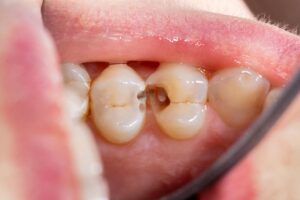
Many people have suffered the dreaded toothache a constant pain that gradually intensifies. Cold drinks, hot foods, or chewing can make it worse.
Usually, the pain appears when the nerve is already involved and is managed with medication (antibiotics and/or anti-inflammatories). The treatment depends on how advanced the tooth damage is.
Tooth pain is the main reason many people visit the dentist; however, in most cases the tooth already has a very advanced lesion, and a root canal is needed to try to save it.
What causes tooth pain?
“Toothache” is caused mainly by inflammation of the dental pulp, known as pulpitis.
When the pulp becomes inflamed, it increases pressure on the tooth’s nerve and surrounding tissues. Because the pulp chamber is surrounded by dentin, it can’t dissipate this pressure; the inflammation raises blood flow, which produces pain.
Pulpitis can present as pain that’s so intense and diffuse it’s sometimes hard to identify exactly which tooth is responsible.
The most frequent cause is an advanced cavity. The carious lesion allows bacteria to enter the tooth until they reach the nerve, where infection develops.
Pulpitis can also arise from trauma, from periodontal diseases such as gingivitis and periodontitis, from a dental abscess, or from temporomandibular joint disorders though these are less common.
What are the symptoms of tooth pain?
Common symptoms include:
- Pain when chewing.
- Sensitivity to cold and hot foods.
- Bleeding around the tooth or gum.
- Constant pain that can involve the jaw, head, and ear.
How is tooth pain treated?
There are two stages of pulpitis: reversible and irreversible.
Dentists diagnose reversible pulpitis when the pulp is still vital and the irritant can be eliminated. Treatment generally involves removing the cavity and placing a filling.
Irreversible pulpitis is diagnosed when the pulp is damaged beyond repair. In this case, treatment requires a root canal, and in some instances tooth extraction.
When you have a constant toothache, it means there is an underlying dental problem. It’s very important to see a dentist for a diagnosis to determine the cause.
While analgesics can relieve pain and many people self-medicate, an antibiotic is necessary when there is infection. Only a dentist can determine the appropriate medication to relieve a toothache safely.
The information in this post is for guidance. Although pain relievers can help, only a dentist can diagnose the cause and decide whether an antibiotic is needed for infection.
Don’t ignore a toothache contact us to schedule an evaluation.