Because of their white color and hardness, teeth are often mistaken for bones. While they share a key component hydroxyapatite they are not the same.
Teeth are hard anatomical organs designed to cut and grind food. They also help modulate the voice and sounds produced in the mouth, so they play an important role in speech.
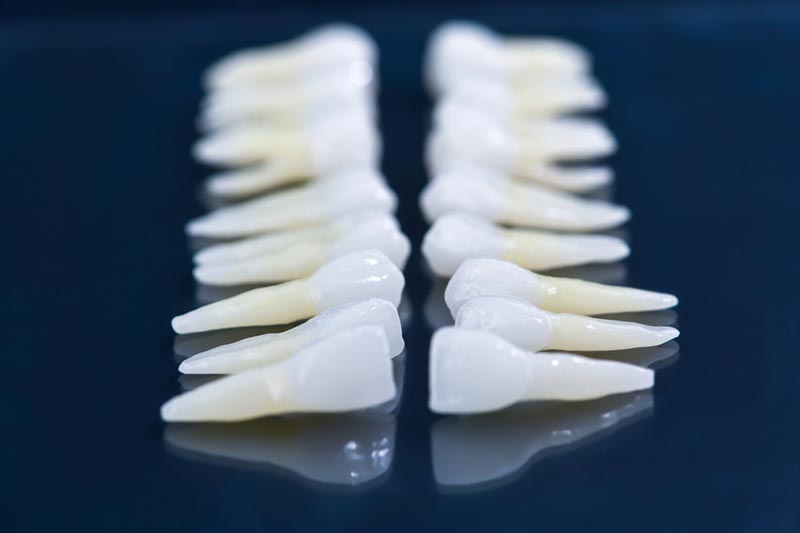
From a morphological standpoint, each tooth has three parts: root, neck, and crown.
The root is the portion embedded in the jaws and covered by the gum. The crown is the visible part of the tooth, and the neck is the junction between the crown and the root.
Each tooth is composed of several layers of tissue with different composition, density, and hardness. The four most important are:
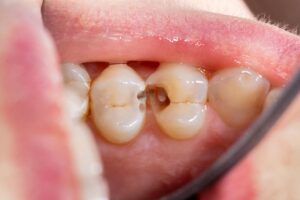
- Enamel: the white outer coating of the tooth. It is the most mineralized and hardest tissue in the body and is made mostly of hydroxyapatite, a mineral that isn’t water-soluble but reacts easily to acids. That’s why sugars are so damaging: when bacteria metabolize sugar, they produce acid that adheres to teeth and causes cavities.
- Dentin: the most abundant tissue in the tooth, located beneath the enamel. It has a yellowish color that influences the tooth’s shade. It also contains hydroxyapatite, but in lower proportion than enamel, which makes it more fragile.
- Cementum: the hard layer that covers the root and anchors the tooth to the alveolar bone via the periodontal ligament. Its function is to fix the tooth to the jaw.
- Pulp: a soft tissue made up of nerves and blood vessels, commonly known as the tooth’s “nerve.” It lies at the center of the tooth and is responsible for sensation.
When do teeth form?
Although they begin to erupt around 6 months of age, baby teeth start developing during the embryonic stage. This temporary dentition consists of 20 teeth.
Starting at about age 6, baby teeth begin to fall out and the permanent teeth erupt. The adult dentition, which has more space, consists of 32 teeth. In some cases the third molars known as wisdom teeth may erupt. If the jaw doesn’t have enough room, these teeth are often extracted to avoid harming neighboring teeth.
The information in this article is for guidance. Although enamel is the hardest tissue in the body, it reacts readily to the acids that cause cavities; that’s why regular checkups are important.
Ensure the health of your teeth book an evaluation with Dr. Daniel Fernández.